
Self-hosted · free · MIT
“I requested this.
Where did it die?”
Your request went into Seerr and never came out. The answer is somewhere across five web UIs, and the symptom almost never matches the cause. Sleutharr follows that one request the whole way and tells you exactly where it broke.
Reads from your services. Changes nothing unless you click a button and confirm.
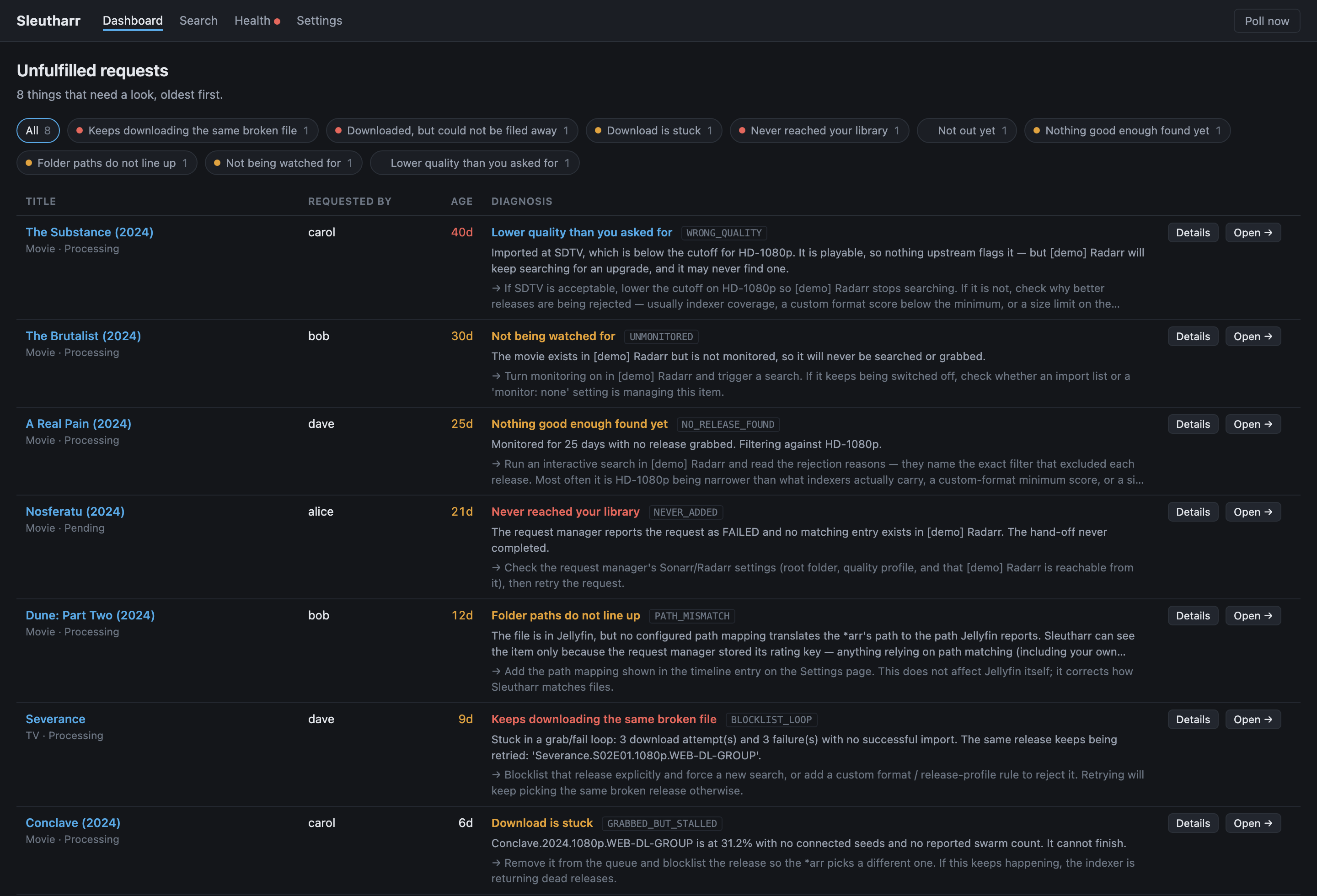
The symptom is never the cause
“no results found”
“100% complete”
“imported”
Each of those takes twenty minutes of clicking between apps to work out. Sleutharr gives you one sentence.
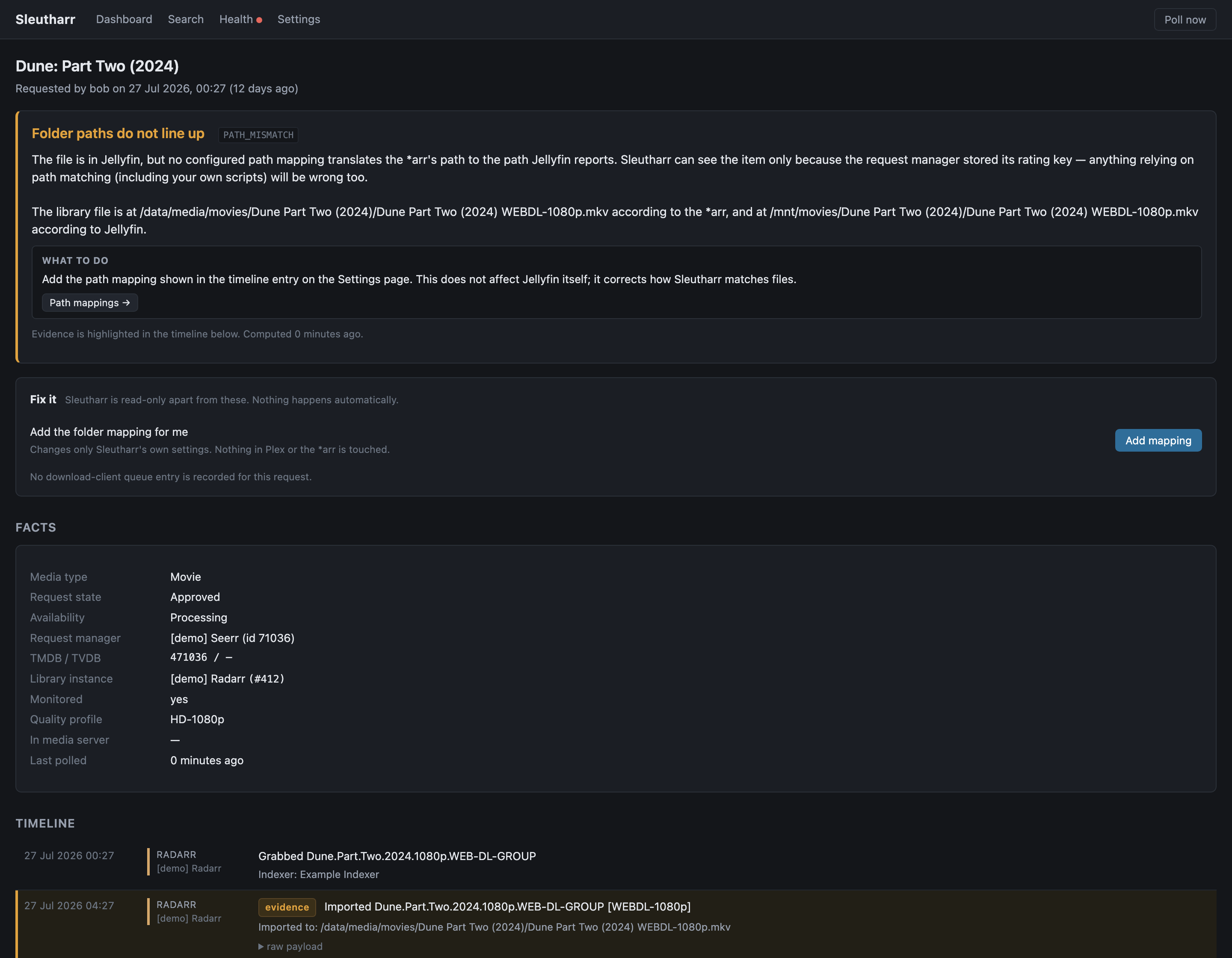
One verdict, with the evidence
Every request gets a single answer in plain English, the timeline it was derived from, and a link straight to the app that owns the fix. Not a dashboard of graphs — a conclusion.
It sets itself up
Add your request manager and press Find my other services. It reads your Sonarr and Radarr instances out of it — addresses, API keys, and the two settings nobody can guess — then reads your download clients out of those. For Plex you sign in with your Plex account and pick a server; there is no token to hunt down.
Request managers
Seerr, Overseerr, Jellyseerr, Ombi
Libraries
Sonarr, Radarr — any number, including 4K splits
Download clients
qBittorrent, Transmission, Deluge, SABnzbd, NZBGet
Media servers
Plex, Jellyfin, Emby
And it can fix some of it
Where there is a single obvious fix, there is a button for it — removing a stuck download and blocklisting the release, retrying a failed hand-off, adding the folder mapping it worked out, or asking your indexers why nothing is being grabbed and showing the exact reason each release was rejected.
Install
Unraid
Docker → Add Container, then:
| Repository | dsopinka123/sleutharr:latest |
| Port | 8080 → 8080 |
| Path | /config → /mnt/user/appdata/sleutharr |
| Variables | PUID=99, PGID=100, TZ |
Docker
docker run -d --name sleutharr \
  -p 8080:8080 \
  -e PUID=1000 -e PGID=1000 \
  -e TZ=Etc/UTC \
  -v ./config:/config \
  dsopinka123/sleutharr:latest
Also on GHCR as ghcr.io/dsopinka/sleutharr. Then open
http://your-server:8080.
Worth knowing before you install
This is early software. It works, it has a test suite, and it runs against real setups — but it has been used by a small number of people, so it will meet combinations it has not seen. Ombi, Jellyfin, Emby, NZBGet, Transmission and Deluge are built to their published schemas and every common scenario is tested against those shapes, but they have not yet been pointed at a live instance. That proves the parsing matches the documentation; it cannot prove a product matches its own docs.
If a verdict looks wrong, that is the useful bug report — nearly every bug found so far was exactly that. It never touches your media files, and it never changes anything in Sonarr, Radarr or Plex without you confirming it.